ionozond: The Echo Window — Every Sounding's Phase in 1.6 MB Instead of 80
The station deletes each capture once its archive verifies, and the archive held power only — so every five minutes the Doppler, the fading and the phase went with the capture. Now an echo window is cut into the archive: the complex signal around the echoes, bit-identical to the reference implementation. How it works, why a capture is deleted only after its window is verified, and how to keep the whole signal.
One sounding of an ionozond station is an 80 MB .lfs capture, and at a 300-second repetition period one station produces about 23 GB a day. Such captures cannot be kept forever, so after each sounding the receiver writes an .h5 archive in the chirpsounder2 format and deletes the capture as soon as the archive reads back. But the archive holds power — a spectrogram. Every five minutes the fast part of the channel went with the capture: the Doppler shift and spread, the fading, and the phase, which carries the group-delay dispersion.
What the echo window is
After dechirping, the echoes occupy a beat band of a few hundred hertz out of the 40 kHz the capture stores. The echo window shifts that band to zero, low-passes it, decimates it and appends the result to the archive as a separate echo_window group. On the captures of the Cyprus station that is 1.57 MB — 1/51 of the capture — and inside the window’s band the signal is kept without loss. The archive grows from 1.25 to 2.81 MB a sounding, about 450 MB a day per station.
The window’s format is set by a specification of the ionograms-handler processing platform, and the reference implementation lives in its muf module. The window in ionozond is held to that reference, not to itself:
- The same window. The range span is the union of automatic gating on the power ionogram and the geometry of one- to three-hop modes, plus 150 km. It follows the echo’s energy, not only the computed path.
- The same samples. Decimation sums the filter taps in the same order as
scipy.signal.upfirdn, so the result is bit-identical to the reference at complex64. That matters:muf’s verifier re-cuts the window with the stored taps and demands identical samples. - numpy and h5py only. SciPy is optional on the station, so the Kaiser filter’s taps are computed from the formula in the specification and stored with the window — a reader does not have to agree with this filter designer.
A check on five captures of 4 February 2026, from 03:00 to 18:00 UTC, gave a full match: the same window of 2486–4112 km, decimation by 45, 3595 taps; of 222,304 samples, not one differs. muf’s own verifier passes: 82.6 dB of stopband rejection, 0.0006 dB of passband ripple. Cutting the window takes 1.9 seconds, after 1.3 seconds for building the products.
One discrepancy did turn up, and it is instructive. In muf’s built-in station table the Cyprus transmitter’s coordinates differ from the capture header by 0.6 km, and muf’s window shifts by the same 0.6 km. Both windows are valid: the coordinates decide, not the implementation.
A capture is deleted only after its window is verified
The window makes sense only if the capture is not deleted before the window is safely kept. A review found two paths by which a capture left without that guarantee.
The first was the receiver’s own immediate deletion. The window was cut without the full check: reading it back proved the bytes had reached the disk, not that they were the right bytes. The filter, the exact re-cut and the re-derived power — what would catch a shift or a sign error after some future change — ran only with the check. And an archive that already had a window let its capture go with no check at all.
The second path was the scheduled clean-up by retention period and the disk-freeing timer. They decided by the power archive, without looking at the window. A capture the receiver had held back because its window failed was deleted a few hours later anyway — and with it the last copy of the phase.
Now a capture counts as ready for deletion only if its archive holds a verified window. A missing window is cut and verified first; a capture whose cut fails stays. Both paths decide through one and the same function, so they cannot disagree about when a capture may go. The scheduled clean-up spends no more than 15 seconds a pass on this, so that a backlog cannot delay the next sounding. On a copy of one capture, the clean-up cut the window, verified it and released the capture in 5.5 seconds.
The whole signal
For those who need the whole capture rather than the window, the console’s parameters gained a checkbox, “Full signal z in the .h5 archive”. It widens the window to the whole band: no shift, no decimation, a single tap — a case the specification already allows. The archive then holds the capture sample for sample and replaces it completely.
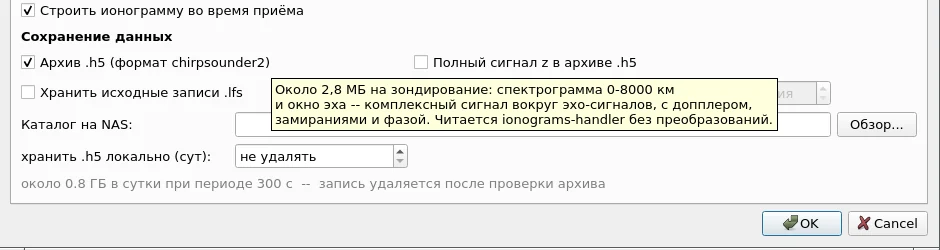
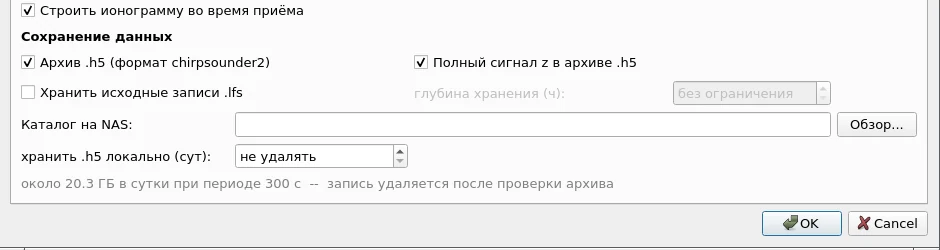
On the capture of 4 February, 12:00, the stored signal matched the .lfs samples, took 69 MB of 80 in the archive with gzip and byte shuffling, and the ionogram muf built from the archive matched the one built from the capture to 0.000000 dB.
The signal is stored inside the window rather than in the root z dataset that chirpsounder2 provides — and that is on purpose. muf reads a root z with the second format version’s timing and would label every frequency 7.5 MHz too low. The window carries its own time and sweep parameters.
Where the window has already helped
The October soundings of the NIC1 — Yoshkar-Ola path are recorded as archives with echo windows. The HF channel simulator reads them from the window rather than from the stored power: the window goes through the original capture’s spectrogram again, so the scale and the conversion to carrier-to-noise density stay the same as for an .lfs. The simulator is the subject of the next breakdown.
The last fix in this series is small but noticeable: synchronisation with the network storage refused to upload archives when the storage was attached by automount. The mount table then holds two entries at one point — the autofs trigger and the share mounted over it — and the program took the first and treated the share as not mounted. Now, as in the kernel, the later one wins.
Conclusions
- Raw data can be deleted only when everything still needed from it is kept: a power archive does not replace the capture, because it loses the phase.
- Almost all the information about the channel sits in a narrow band: a window of 1/51 of the capture keeps it without loss.
- Compatibility with a reference is better proven by bit-identical samples than by plots that look alike.
- The decision “may this be deleted” should be made in one place: two independent rules will sooner or later disagree.
Availability
The source code is open.
- Source code: github.com/nikita-konkin/ionozond
- Interactive models: konkin-nikita.ru/ionozond-playground
Tags
More project updates
ionozond: A Chirp Ionosonde Console Recovered from Its Binary
The source of an oblique chirp-sounding console was lost; only the built binary remained. How the program was recovered from it and shown to match the original, which quirks had...